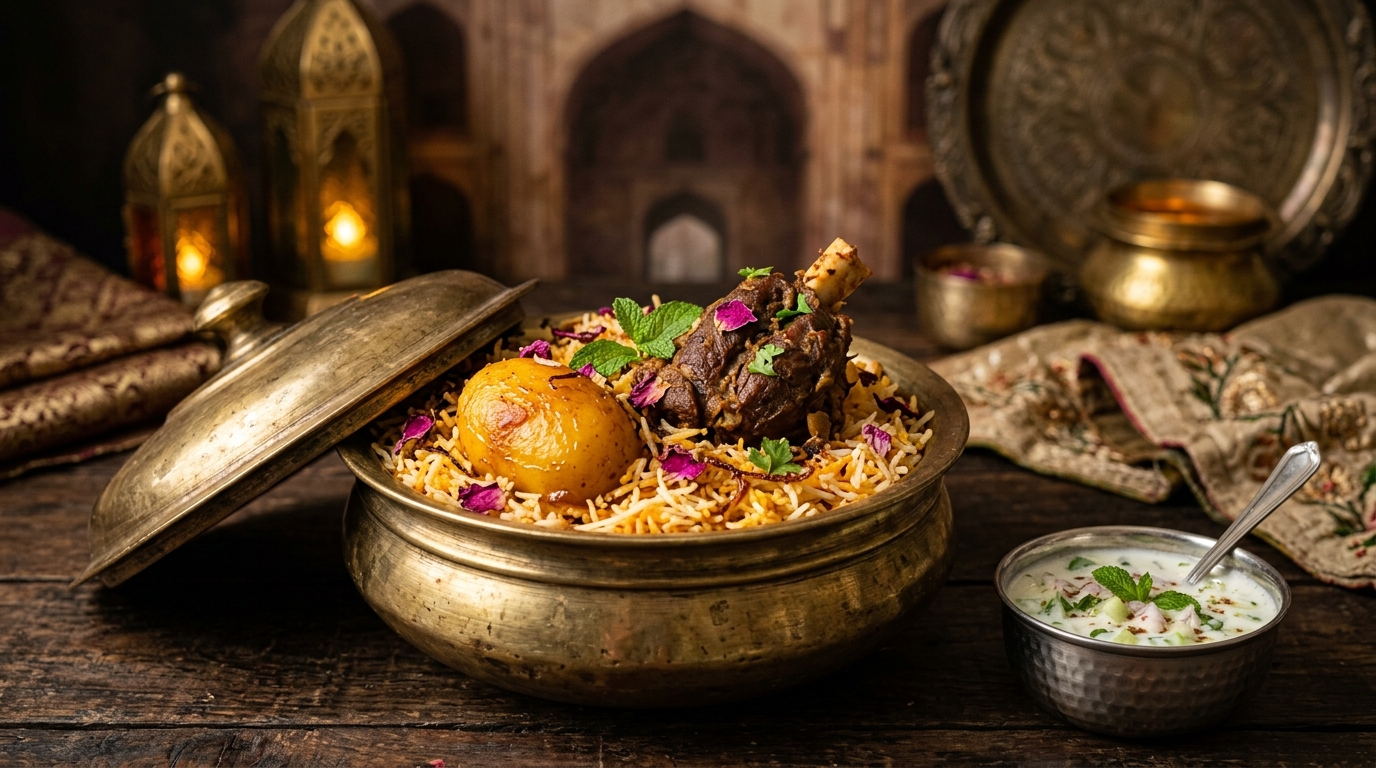
The Kolkata Biryani (also spelled Kolkata Biriyani) originated in Metiabruz, Kolkata, during the 1856 exile of Nawab Wajid Ali Shah. To feed his large royal entourage on a constrained British pension, the Nawab’s master cooks (khansamas) adapted the traditional Awadhi dum pukht biryani by ingeniously incorporating potatoes — creating the distinct, aromatic, and remarkably mild signature dish celebrated globally today.
The Dish That Carries a History
Of all the things Nawab Wajid Ali Shah brought from Lucknow to Metiabruz — the music, the architecture, the poetry — nothing has touched more lives than what happened in his kitchen.
The Kolkata Biryani is today one of the most beloved regional dishes in India. Recognisable by its single large potato, its gentle saffron fragrance, and its notably milder spice profile compared to Hyderabadi or Lucknowi versions, it has fed generations of Kolkatans and now travels the world through restaurants and cloud kitchens from London to Dubai.
But its origin is a story of loss, adaptation, and the stubborn refusal of a royal culinary tradition to disappear.
Part I: What the Nawab Brought with Him
When Wajid Ali Shah left Lucknow in 1856, he carried with him the full apparatus of the Awadhi court — including its kitchen.
The cooking tradition of Awadh was one of the most sophisticated in the subcontinent. Its defining technique was dum pukht: slow-cooking sealed inside a heavy-bottomed vessel (handi), the lid sealed with dough to trap every drop of steam. In this enclosed environment, the rice, meat, saffron, and aromatics cooked together, each layer absorbing the other’s flavour. The result was not just rice and meat — it was a single unified dish, impossibly fragrant, impossibly tender.
The Awadhi biryani’s particular character came from its restraint. Where Hyderabadi biryani uses bold spices and a bright acidity, the Lucknowi style was delicate — rose water, a whisper of ittar (perfume), saffron milk, and just enough spice to heighten without overwhelming. It was, in every sense, a dish designed for a court.
The cooks (khansamas) who had served the Nawab in Lucknow followed him to Calcutta. They set up kitchens in the sprawling estate at Garden Reach and continued the tradition exactly as they had before — for a while.
Part II: The Problem of Feeding a Court in Exile
The Nawab was not destitute. The British granted him an annual pension of twelve lakh rupees — a sum that would have been generous by any ordinary standard. But Wajid Ali Shah was not an ordinary man in an ordinary circumstance. He had brought with him thousands of followers: courtiers, servants, musicians, tailors, poets, cooks, and their families. He was also maintaining the fiction — and the reality — of a royal court: hosting gatherings, employing artists, maintaining a zoo, commissioning buildings.
Twelve lakh rupees, stretched across that entire enterprise, was not a fortune. It was a constrained budget for an operation that had previously been funded by the revenues of a kingdom.
The khansamas faced a practical challenge: how to produce biryani at royal volume without the royal supply of meat. In Lucknow, the biryani was generous — pieces of slow-cooked mutton layered through fragrant rice. In exile, the ratio needed to change. The meat portion per person had to shrink. But the dish still had to feel like a feast.
Part III: Why Does Kolkata Biryani Have a Potato?
The short answer: When the royal budget tightened in exile, the Nawab’s chefs substituted a portion of the meat with a whole potato slow-cooked in the dum pukht method. The potato absorbed the full flavour of the mutton fat, saffron, and spices — becoming indistinguishable in richness from the meat itself.
By the 1850s, the potato had been in India for roughly two centuries. The Portuguese had introduced it in the early 17th century, and the British East India Company had actively promoted its cultivation in Bengal. By the time Wajid Ali Shah arrived in Calcutta, potatoes were commercially available in Bengal — not yet the ubiquitous cheap staple they would become, but no longer a rarity.
They were, however, new to the royal Awadhi kitchen. The cuisine of Lucknow had developed around ingredients familiar to north Indian courtly cooking. The potato had not featured in traditional Awadhi biryani. For the khansamas, who had spent decades cooking a specific canon of dishes, this tuber represented an unfamiliar ingredient — even if the Bengali markets carried it freely.
So both statements are true simultaneously, and they describe different things:
- “Budget was constrained” → relative to running an actual kingdom, not by any absolute measure of poverty
- “Potato was exotic” → exotic to the Awadhi culinary tradition, not to Bengal generally
The khansamas discovered that the potato, when slow-cooked in the dum pukht method, did something extraordinary: it absorbed the rendered fat of the mutton, the saffron-milk, and the layered spices until it tasted of the biryani itself. A single large potato, cooked this way, carried the full flavour of the dish. It wasn’t a substitute for meat. It was something new.
Part IV: What Makes Kolkata Biryani Unique — The Flavor Profile
Kolkata Biryani is the mildest, most aromatic of India’s major biryani styles. It uses almost no chili, and its fragrance comes primarily from floral and fruity aromatics rather than heat.
The key ingredients that define its character:
- Saffron (kesar): Steeped in warm milk and drizzled over the rice, giving it a golden tint and a delicate floral note.
- Rose water (gulab jal): Sprinkled at the final stage of cooking, contributing a perfumed sweetness.
- Kewra water (kewra jal): An extract of screwpine blossoms, it provides the unmistakably Awadhi floral aroma.
- Ittar (natural perfume): Occasionally a single drop is added to the finished dish, a practice carried directly from the royal kitchen.
- Warm whole spices: Cardamom, cinnamon, mace (javitri), and nutmeg (jaiphal) — used in small quantities for warmth, not heat.
- The potato: Whole, slow-cooked in the meat stock until it turns golden and absorbs every layer of flavour.
- Boiled egg (in many versions): A later addition that became a beloved part of the dish’s identity.
The result is a biryani that smells like a garden and a palace simultaneously — gentle, complex, and utterly unlike anything else on a menu.
Part V: Kolkata Biryani vs. Hyderabadi vs. Lucknowi — A Comparison
This is one of the most searched questions in Indian food culture. Here is an honest, direct comparison of the three major styles:
| Feature | Kolkata Biryani | Hyderabadi Biryani | Lucknowi (Awadhi) Biryani |
|---|---|---|---|
| Origin | Metiabruz, Kolkata (1856) | Hyderabad (18th century) | Lucknow, Awadh |
| Spice Level | Very mild | Bold & spicy | Mild-moderate |
| Aroma | Floral (rose water, kewra, ittar) | Spiced (fried onions, chili) | Floral-spiced |
| Cooking method | Dum pukht (layered) | Kacchi (raw meat in rice) | Pakki (cooked separately) |
| Signature element | Large whole potato | Fried onions (birista) | Tender meat, no potato |
| Colour | Pale gold (saffron) | Deep orange-red | Light gold |
| Who invented it? | Nawab Wajid Ali Shah’s chefs in Metiabruz | Nizam’s court chefs | Awadhi Nawabi court |
Part VI: The Myth of the “Poor Man’s Substitute”
Today, the most common telling of the Kolkata biryani origin is a story of poverty: that the potato was a cheap filler used because the Nawab was broke. However, modern food writers and historians urge caution with this colonial-era narrative.
The Novelty Theory: If the potato was still a relatively new and exotic crop in India during the mid-19th century, its addition to a royal dish would have signalled novelty and prestige rather than shortage. It was only later, when the potato became a cheap, ubiquitous staple in Bengal, that the narrative of “poverty and compromise” took hold.
The Culinary Fusion Theory: As Scroll.in notes in its exploration of Kolkata’s Awadhi food hubs, while the “partial replacement for meat” story is deeply ingrained, the potato’s inclusion was more likely a natural act of fusion. Bengal loves the potato, and adding it to the dum pukht biryani — where it would perfectly absorb the complex spices and rendered fats — was a culinary masterstroke, not just an economic compromise.
There is no single historical document that records the first time a potato went into a Kolkata biryani pot. What we have is a story that is substantially true in its larger shape: an Awadhi culinary tradition came to Bengal, adapted to new ingredients, and produced something that became genuinely its own.
Part VII: How It Became “Kolkata’s” Dish
For decades after the Nawab’s death in 1887, the biryani was associated primarily with the Muslim community of Garden Reach and Metiabruz — the community that had descended from the Nawab’s entourage and maintained the tradition through generations.
It spread slowly: first through local biryani shops serving the working-class Muslim neighbourhood, then through the city as a whole, and eventually through India and the diaspora. As it spread to wider markets and smaller budgets, the potato became even more central — now explicitly as a way to make a generous-feeling dish affordable. What began as a royal kitchen compromise became a democratic street food staple.
Today, Kolkata biryani means: one portion of rice, one piece of mutton, one large potato. Always. It is the non-negotiable that distinguishes it from every other biryani style in India.
Part VIII: Where the Tradition Lives On — Iconic Kolkata Biryani Restaurants
The biryani tradition born in Metiabruz now defines Kolkata’s culinary identity. These heritage establishments carry the unbroken lineage of the Nawab’s kitchen:
- Arsalan (Park Circus): Perhaps the most famous name in Kolkata biryani, Arsalan has been serving the definitive version since the 1970s. The queue outside its Park Circus outlet is itself a Kolkata institution.
- Aminia (New Market): One of the oldest biryani houses in the city, established in 1929. Aminia’s recipe is famously close to the original Metiabruz tradition.
- Shiraz Golden Restaurant (Park Street): A stalwart since 1941, Shiraz is known for its reliably traditional preparation and the purity of its Awadhi flavour profile.
- Royal India Hotel (Chandni Chowk area): Claims a lineage stretching back to the Nawab’s original Metiabruz cooks, making it a historically significant stop for anyone tracing the dish’s origins.
All of these establishments trace their recipes — directly or through lineage — back to the khansamas of Metiabruz.
Editorial note: The origin story of the Kolkata biryani potato is substantially supported but not documented in primary sources. Where this article says “the khansamas discovered” or “the potato absorbed,” these describe the most credible reconstruction of events as understood by food historians — not a verbatim historical account.
Read the broader history of Metiabruz →
Frequently Asked Questions
Kolkata biryani was invented by the royal chefs (khansamas) of Nawab Wajid Ali Shah, the last Nawab of Awadh, in the Metiabruz district of Kolkata. After the Nawab was exiled from Lucknow in 1856, his cooks adapted the traditional Awadhi dum pukht biryani to the conditions of exile, creating the distinct Kolkata style.
The potato was introduced by the Nawab's chefs to supplement the reduced meat portions when the royal budget became constrained in exile. The potato, cooked whole in the dum pukht method, absorbed the full flavour of the mutton fat, saffron, and spices — making it as satisfying as meat itself.
No. Kolkata biryani is the mildest of India's major biryani styles. It uses almost no chili, and its flavour comes primarily from floral aromatics like rose water, kewra water, and saffron.
Kolkata biryani is mild, aromatic, and always includes a large whole potato. Hyderabadi biryani is spicier, uses fried onions (birista) for flavour, and does not contain potato. Hyderabadi uses the kacchi method (raw meat cooked in rice), while Kolkata uses the layered dum pukht method.
Kolkata biryani originated specifically in Metiabruz, a historic neighbourhood in south Kolkata. It was here that Nawab Wajid Ali Shah built his exile court — Chhota Lucknow — after 1856, and where his royal chefs invented the dish.
Sources & Further Reading
- Hindustan Times — "Done with Kolkata's fish and sweets? Try its biryani"
- The Better India — "The Story Behind Kolkata Biryani's Potato"
- The Hindu — "Eat Like a Royal"
- Scroll.in — "Ramzan food: Exploring iftar in one of Kolkata's oldest neighbourhoods"
- Sahapedia — "Culinary Heritage of Awadh in Kolkata"
- Wikipedia — Wajid Ali Shah